
Savings Opportunities with PLC-Based Solutions
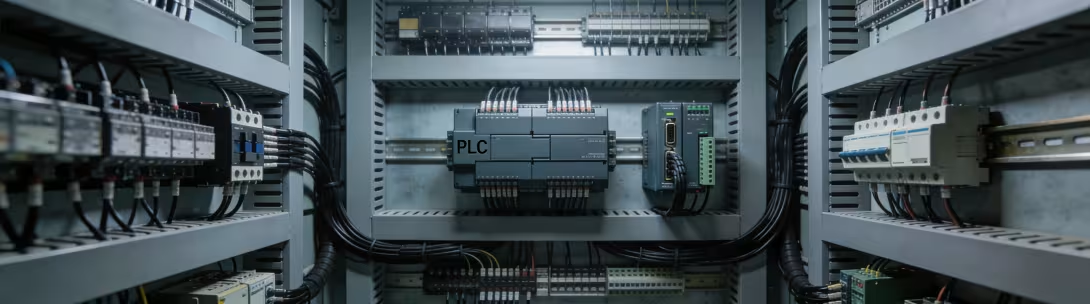
Why can a centralized, PLC-based control system remain relatively affordable in the case of new-build properties?
With PLC-based smart home control solutions, thanks to the ability to integrate with external devices—if planned properly and at the right time—it is also possible to achieve material savings compared to traditional, non-smart homes, which can partially offset the additional cost of building a smart home. To make this easier to understand in practice, let’s take a 4-room family house with, in addition to the living rooms, a kitchen, dining room, living room, 2 bathrooms, a walk-in closet, a utility room, a pantry, a garage, at least one corridor, an entrance hall, and outdoor lighting. We use the PLC to control the lighting and a 5-zone garden irrigation system.
With centralized PLC control, it is sufficient to install one switch—or even just a simple push-button—at each point, whereas in a traditional setup
- for lighting controlled from 2 locations, 2 two-way switches are required,
- for lighting controlled from 3 locations, 2 two-way switches and one intermediate switch are required.
In addition, with the PLC we can eliminate the need for a dedicated irrigation controller, but we will need at least one transformer to drive the solenoid valves.
Let’s create a sample calculation based on the above; for this we need to make a few assumptions:
- at minimum, the living room, the dining room, a utility room (e.g., pantry), the garage, and one bedroom (typically the master bedroom) have lighting that can be controlled from 2 points,
- and in the corridor, the entrance hall, and outdoors we want to control the lighting from 3 locations.
In this “minimal scenario” (we are not taking into account that nowadays a room typically does not have just one lighting circuit; in many rooms—and at least in the living room—besides the traditional ceiling light, spotlights and/or LED strips are also installed, which in a traditional setup we would also want to control separately by circuit), the difference in material cost between the two installation requirements, calculated with one of the most common mid-range Legrand product lines, is as follows:
| Device type | Quantity | Gross unit price (retail list price) | Gross cost | Savings | ||
| Traditional setup | Smart home | Traditional setup | Smart home | |||
| Legrand Valena Life 752101 single-pole switch | 0 | 19 | 1 855 Ft | 0 Ft | 35 245 Ft | -35 245 Ft |
| Legrand Valena Life 752106 two-way switch | 16 | 0 | 2 540 Ft | 40 640 Ft | 0 Ft | 40 640 Ft |
| Legrand Valena Life 752107 intermediate switch | 3 | 0 | 4 018 Ft | 12 054 Ft | 0 Ft | 12 054 Ft |
| Total | 19 | 19 | 52 694 Ft | 35 245 Ft | 17 449 Ft | |
In addition to the above, instead of the double-core copper wiring sized for the electrical load (typically with a 1.5 mm2 cross-section) that is required between two-way and intermediate switches, in practice a single conductor with only the minimal cross-section needed to drive the PLC input port (even 0.25 mm2) is sufficient.
On top of these savings, you also save the cost of at least a 5-zone irrigation controller (compared to this, the price of an AC transformer is negligible). The price of a HUNTER outdoor irrigation controller capable of approaching the PLC’s remote-control capabilities is more than 110,000 Ft.
To provide the funct