
Smart Home, Smart Choices
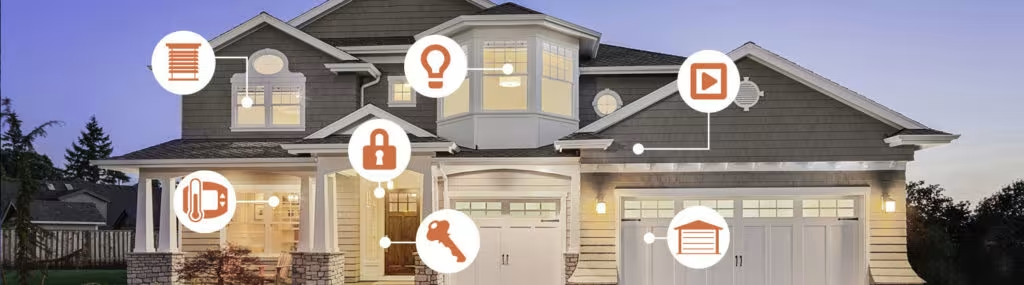
Fortunately, smart homes are no longer something only the top ten thousand can afford. With forward-looking and thoughtful planning, a smart home can be created with only a minimal additional investment compared to a “traditional” setup, and the material cost of the extra components required (controllers, cabling) is partially offset by the simpler electrical installation. Of course, this is only true for certain types of solutions, as the number of control options available on the market is enormous, which makes it increasingly difficult for homeowners to navigate the noise and choose the solution that best fits their needs.
The possible solutions can be integrated at different levels and offer different advantages. However, if we look behind the scenes, we can essentially group them into three main categories.
Wireless, decentralized systems
Today, so‑called smart devices can be ordered in large quantities from Hungarian and Chinese webshops at relatively low prices, often for just a few thousand forints. The best-known brands and product families used on the Hungarian market are Tuya/Smarthome, Sonoff, and Xiaomi‑compatible devices.
These are typically devices that use various wireless standards (Wi‑Fi, Zigbee, Z‑Wave, dedicated RF channels, etc.)—switches, smart remotes, valve controllers, shutter switches, and so on—which all have in common that, in addition to the hardware itself, the manufacturers provide a closed software environment through which the devices can be configured and controlled, and automations (“routines”) can be created.
This is clearly the cheapest option, but in return its reliability and stability often leave something to be desired. The reliability of Wi‑Fi‑based devices in particular tends to be low, because in a modern household the sheer number of Wi‑Fi devices can easily overwhelm consumer‑grade networking equipment. In addition to the often unstable operation—for example, a switch may not respond to a command, or may turn on even without receiving one—the data are also stored on remote servers (in the cloud), and every command and routine runs through these servers. Because of this, potential buyers are often warned that these devices are only for those who are not worried about the idea that some of their household devices could theoretically be controlled from, say, China.
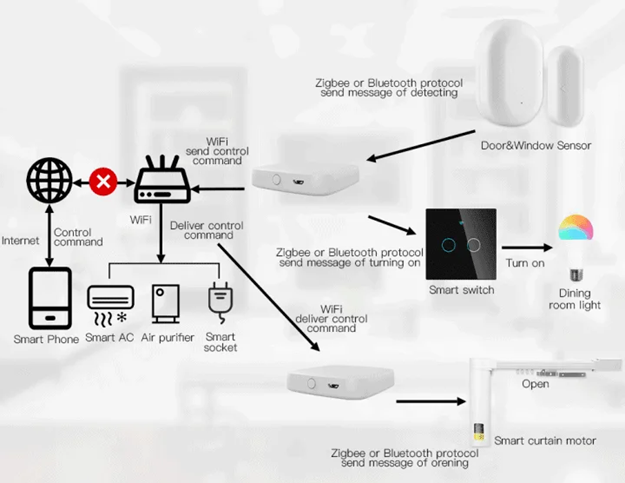 In practice, however, we are not aware of any real‑world cases where the companies operating these servers have misused the data (so far), and in addition, for devices installed in the EU, most manufacturers’ data centers are typically also located within the EU. The real concern is rather what happens if the server operator disappears one day or the servers simply become permanently inaccessible to us. In everyday life, the impact of this model is felt mainly in the fact that if the internet goes down, the functions controlled by smart devices stop working as well. In such a situation, for example, a garage door that cannot be opened from the outside can quickly become a very unpleasant problem.
For this reason, in the case of new‑build properties we do not recommend this type of solution, or only for limited, less critical functions. Critical functions such as heating/cooling control should definitely not be managed with these devices (there are exceptions, for example a thermostat where the “smart” part is only used to adjust the settings, while the thermostat itself is connected to the heating system via a traditional, wired connection—such a device can be integrated without issue).
For the sake of completeness, it is important to highlight that the above remarks apply only to new properties that are still under construction and below a certain stage of completion. For existing properties that are to be “upgraded” with smart features, often this is the only realistic option, as all other alternatives would require an investment several orders of magnitude higher.
Industrial solutions
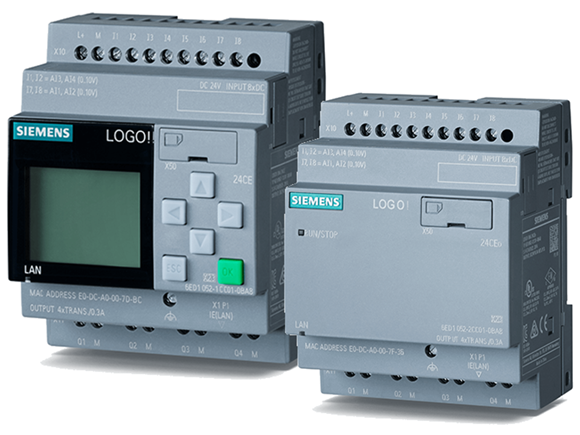 The best‑known devices in this category are PLC controllers, as well as solutions based on Arduino, and more rarely, controller modules built on Raspberry Pi.
PLCs (Programmable Logic Controllers) were originally designed for industrial automation tasks, which is why they are considered exceptionally reliable devices. They are built to operate continuously for years—or even decades—24/7, often under harsh conditions. This robust design and stable hardware are key reasons why PLCs are worth using in residential automation as well.
Another cornerstone of their reliability is the simplicity and transparency of the system. PLCs run on special control software based on industrial standards, which carries a minimal risk of failure and behaves in a highly predictable manner. Error handling is built into their operation, meaning that if some irregularity occurs, the controller automatically falls back to a safe state, preventing the system from collapsing unexpectedly.
They also offer long service life and excellent stability: a well‑configured PLC system requires very little maintenance. Since PLCs have proven themselves in industrial environments, they are also perfectly suitable for controlling a family home or office, where uninterrupted, continuous operation is expected. Control logic can be programmed flexibly, which makes it possible to fully tailor the behavior of the system to the owner’s specific needs.
Overall, PLC controllers are considered reliable because they are built on durable hardware, operate in a stable and well‑proven software environment, and provide automated error handling. This makes them an excellent choice for those who are looking for a long‑term, safe, customizable smart home solution with an excellent price‑to‑performance ratio.
Centralized smart home systems
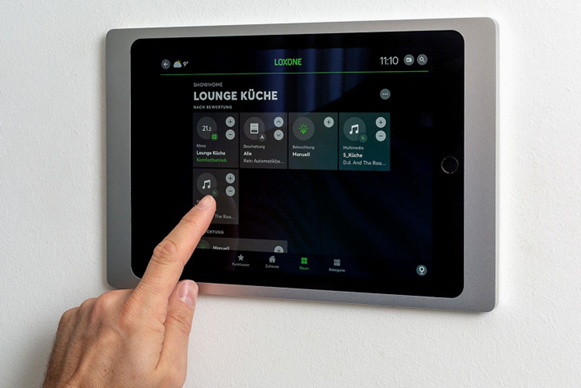 Systems developed specifically for smart homes are built around a single central controller that coordinates the functions of the house—lighting, shading, heating and cooling, security, access, audio, and energy management—in a pre‑designed way, so that day‑to‑day operation becomes convenient, consistent, and largely automatic. The strength of such systems lies in the manufacturer’s ecosystem: components are compatible, the logic is based on predefined patterns, the user interface is unified, and troubleshooting and maintenance are transparent. As a result, operation is stable, response times are fast, the system can often work even without an internet connection, and it can save energy by adapting automations to the home’s actual state. For new builds it is particularly attractive, because a wired topology is reliable in the long term and behaves predictably even under heavy load.
On the downside, you have to factor in the higher initial cost and the fact that this more closed ecosystem tends to be less “plug‑and‑play” with third‑party devices. Although more and more systems offer integrations based on industrial and building automation standards (e.g., KNX, Modbus, DALI), integrators will typically try to steer clients towards the manufacturer’s own ecosystem in order to make full use of its advantages.
Comparison of the different solutions
| Criteria | 1. Wireless, decentralized systems | 2. Industrial solutions | 3. Centralized smart home systems |
|---|---|---|---|
| Installation characteristics | Decentralized | Centralized, but can be combined with decentralized devices as well | Centralized, but can be combined with decentralized devices as well |
| Operational reliability | Low | Highest, meeting industrial‑grade expectations | High, tailored to residential usage needs |
| Durability | Still limited experience, but a few years at least. Most devices show sensitivity to induced effects (we have had to replace multiple units after major storms). | Thanks to industrial standards, PLCs are almost indestructible; due to their design philosophy and architecture they are considered truly reliable in practice. | Often PLC‑based, but the kind of reliability data common in industrial standards are not available; from this perspective, devices are typically not certified. |
| Convenience | High | Different products are typically integrated via open‑source applications using industrial or manufacturer communication standards, enabling completely custom interfaces tailored fully to the client’s needs. | With a standard setup, the highest |
| Integrability with external devices | None, but many manufacturers offer a very wide range of products for practically every use case. | Broad integration options thanks to standardized or standardized‑and‑extended logic. | None or heavily limited. |
| Long‑term operational risk | Since owners have no influence over the operation of the server infrastructure required for these systems to work, the risk is clearly high. | Thanks to open‑source solutions or technologies that have been widely used in industrial environments for decades with long support lifecycles, operational risk is the lowest. | The closed manufacturer ecosystem offers no solution if the vendor ceases to exist, but because data are stored locally, the risk is still significantly lower than with Tuya, Sonoff, and similar systems. |
| Installation cost for new builds | Low | Medium | Highest |
| Installation cost for existing properties | Low | High | Highest |
| Recommended for | Property owners who want to add smart features to their existing homes. | Those building a new home who prefer open architectures and custom solutions, and are looking for the best possible price‑to‑performance ratio. | Fans of perfect design and strong brands who are not bothered by a closed architecture and higher installation costs than with other solutions. |
Contrary to some pseudo‑scientific opinions you may find in obscure corners of the internet, smart home control systems built with PLC‑based solutions do not lag behind significantly more expensive dedicated smart home systems (such as Loxone) in terms of stability, reliability, or breadth of functionality—in fact, they often surpass them. With the right choice of components and a well‑planned system design, PLC‑based control can come close to, and in some respects even exceed, these systems in terms of user experience as well. Naturally, the more highly customized user experience someone wants, the deeper they will have to reach into their pocket because of the development time required, so beyond a certain point the cost of a PLC‑based system can reach the same order of magnitude as that of dedicated smart home controllers—but in that case the user truly receives an extremely refined and polished user interface.
It is very important to emphasize that the exact design can only be determined after assessing individual needs and constraints, and for PLCs the most cost‑effective yet comprehensive solution is typically achieved with a combination of different types of devices. It is also crucial to ensure that the system design allows for future expansion, because—as with most smart home systems—final requirements usually evolve during day‑to‑day use, once enough real‑world experience has been gathered with the routines configured at the start.